

Grilled veal: the meat is still pink in the middle, and the reason people from Quảng don't dip it in fish sauce



People trying bê thui (seared veal) for the first time often ask the same question: is this meat cooked yet?
It's cooked. It's just unevenly cooked, and that's intentional. The whole calf was roasted over straw fire, the outer skin charred until crispy, while the meat inside still keeps its pale pink color. When sliced, each piece has three distinct layers: the golden-brown skin, a thin, almost translucent layer of fat, and then the pink meat.
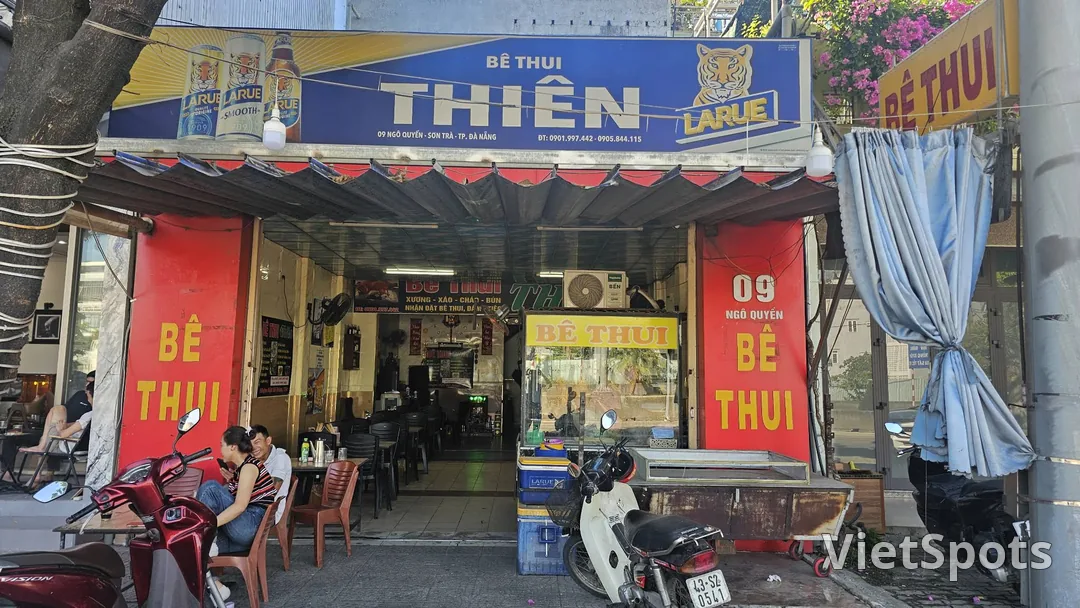
The full name of the dish is "bê thui Cầu Mống" (charred grilled veal), named after Cầu Mống village in Điện Phương commune, Điện Bàn district, Quảng Nam. People in the village say the dish was born around the 1960s, then spread throughout the Quảng region and into Đà Nẵng.
Điện Phương — sounds familiar? That's right, the very same commune that gave birth to Mì Quảng Phú Chiêm. A commune by the Thu Bồn River, two specialties, and both rest on the same thing: whatever is raised on that land turns out delicious.
As for the roasted young beef, it's young calves from the Gò Nổi region — an alluvial flat that the Thu Bồn River replenishes with silt after every flood season. The calves chosen are around twenty to thirty kilograms, raised on sugarcane tops. If it's to be smoked, smoke it with straw mixed with sugarcane bagasse, not charcoal and not gas. This is the part that annoys craftsmen most when it's rushed: straw fire gives that sweet smoke and even heat all around, but if you sear it with anything else, the skin comes out neither crispy nor free of a lingering off-smell.
But what determines whether a plate of grilled beef is delicious or not isn't the meat. It's the fermented fish sauce (mắm nêm).
Grilled whole roasted beef isn't dipped in mixed fish sauce, and not in soy sauce either. It's dipped in mắm nêm — fermented anchovy sauce made from whole anchovies, mashed with minced pineapple, garlic, chili, and a bit of sugar. It's thick, strong-smelling, with a murky brown color. People smelling it for the first time often hesitate a little. But if you swap in the sweet-and-sour fish sauce, the whole plate loses its base: young veal is naturally delicate and needs something salty and fragrant enough to lift it up.
To eat, you wrap it. Take a thin rice paper wrapper, place a slice of meat, add some green banana, star fruit (carambola), cucumber, a handful of fresh herbs, roll it up snugly, then dip it in generously. The green banana and star fruit aren't there for decoration — the astringency and sourness cut through the fattiness of the meat; without them, you'd feel sick of it by the fifth bite.
In Da Nang, roasted beef (bê thui) restaurants are usually open from noon until late at night, since this dish is more for a table of many people than a meal for one. The price is calculated per plate, typically starting from around 50 thousand VND depending on the portion, and it's often ordered together with porridge or vermicelli to make sure you're full.
The pinned shop below is located in the Son Tra area, open from 9:30 AM to a bit after 9 PM. If you're going in a big group, you should call ahead — bê thui (charcoal-roasted young beef) shops often run out of the good cuts by the end of the day.
Comments