

Cao lau: the name means "brought upstairs," and the noodle strands must be soaked in lye water

At first glance, cao lầu can easily be mistaken for mì Quảng. Both have yellow noodles, both use little broth, both are served with fresh herbs and rice paper. But one bite tells you they're completely different — cao lầu noodles are much chewier and drier, with a springy bite, closer to Japanese noodles than to rice vermicelli.
The difference lies in the noodle-making step. The rice isn't soaked in ordinary water but in lye water, made by boiling ash from firewood gathered on Cham Island. The lye water is alkaline, which changes the structure of the rice grains, so the noodles turn out both yellow and chewy-dry rather than soft and mushy. This is also why making cao lầu the authentic way is difficult, and why once you leave Hội An, few places manage to make it taste the same.
As for the name, there's a rather down-to-earth explanation. Back when Hoi An was still a bustling trading port in the 17th century, wealthy merchants who came to the eatery liked to sit upstairs, so the dish was carried up to them. People kept calling it that until it became a habit, and it was eventually shortened to just the two words "cao lầu" (meaning "upstairs").
The dish itself is a product of that port — bearing traces of the Chinese, traces of the Japanese, blended into the eating habits of the people of Quang, until it became something found nowhere else.
In a standard bowl of cao lầu, there are: noodles, a few slices of xá xíu (five-spice marinated pork, roasted until golden-red), fresh herbs, blanched bean sprouts, and the indispensable ingredient — a few crispy square pieces of crackling, which are actually cut from the very same dough used to make the noodles. There's very little water — just a few spoonfuls of thick, syrupy water at the bottom, enough to mix.
Mix everything together from the bottom up when you eat it, just like mì Quảng. Squeeze in some lime, add chili. Many people also add chili sauce — it's up to your taste, but you should try it plain first, since the char siu flavor is already quite rich on its own.
In Da Nang, cao lau restaurants are fewer than those serving mi Quang or bun cha ca. If you want to eat the most authentic version, you still have to go to Hoi An, about 30 km from the city center. But there are also a few decent places in the city, priced around 25,000–45,000 dong a bowl.
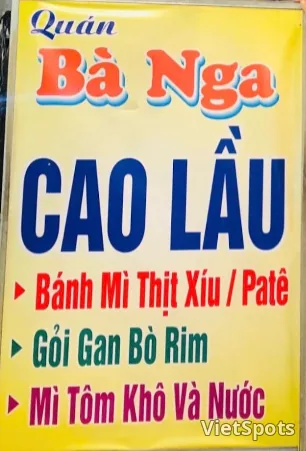
The pinned restaurant below is in Hai Chau district, and there's a notable point: it's open from 3 PM to 10 PM. This is the kind of place for afternoon snacks and dinner, not a breakfast spot — if you go at noon, it'll be closed.
Comments