

Da Nang was formerly named Tourane — and five villages that were cut off in 1888 still remain on the map


Hai Chau. Phuoc Ninh. Thach Thang. Nam Duong. Nai Hien Tay.
If you live in Da Nang or have been here for a few days, you have passed by at least one of those five names — they appear on ward name signs, on house addresses, on directional signboards.
Those five names share a common origin, and it lies in a document signed nearly 140 years ago.
Edict of October 3, 1888
That day, Emperor Đồng Khánh was forced to sign a decree with three provisions, according to which the lands belonging to the cities of Hanoi, Haiphong, and Da Nang became French concessions — meaning that the court renounced all authority over those territories.
The accompanying regulations state clearly: five villages of Hoà Vang district located on the left bank of the Hàn River — Hải Châu, Phước Ninh, Thạch Thang, Nam Dương and Nại Hiên Tây — were ceded to France to establish the concession city of Đà Nẵng, which the French called Tourane.
In other words: the administrative map you're using today still keeps the names of five villages that were cut away in one morning in 1888. In a few more days, it will be exactly 138 years.
And where did the name "Tourane" come from?
I can't say for sure on this one. Some theories suggest it's a corrupted pronunciation of "Cửa Hàn," passed down and recorded over many generations by foreigners; other theories trace it back to a place name of Cham origin. The hypotheses are still debated and I haven't seen any conclusive enough to assert. Only one thing is certain: the French used that name for nearly sixty years.
What does that city look like
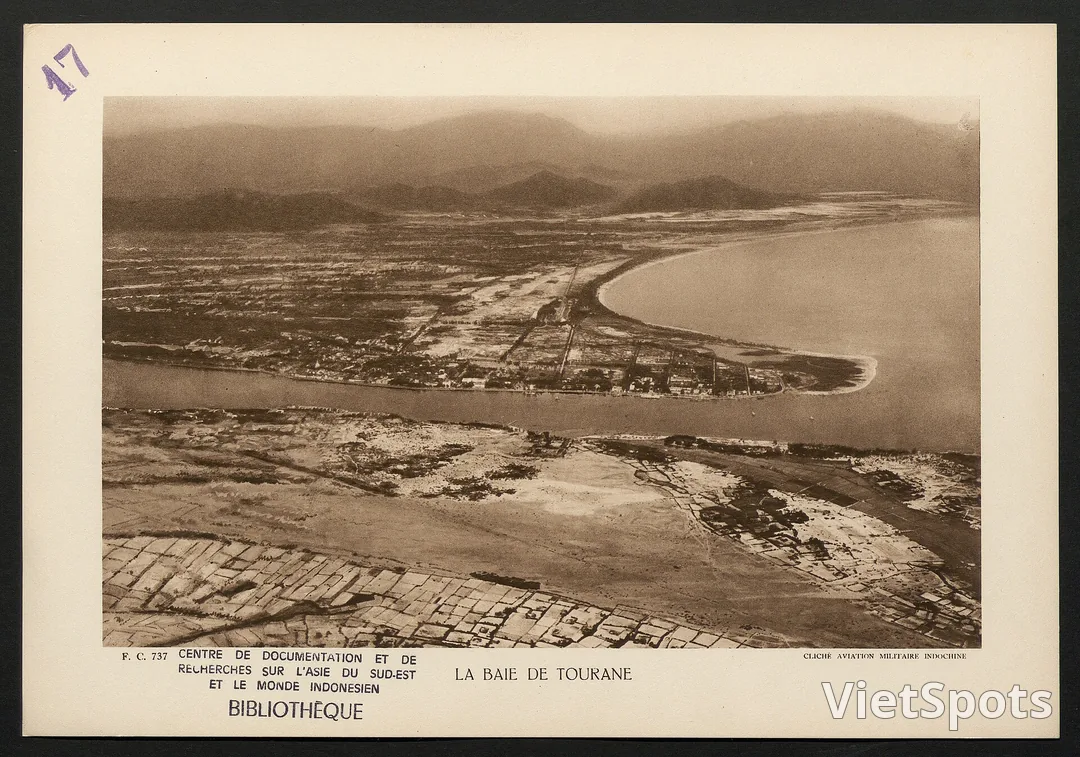
The photo taken from a plane above shows a spot that people in Da Nang today would recognize right away: a curving strip of sand hugging the bay, the Han River cutting across it, mountains faint in the background. But the city itself was almost nonexistent yet — houses clung to a thin strip along the river, and the rest was just fields and sand.
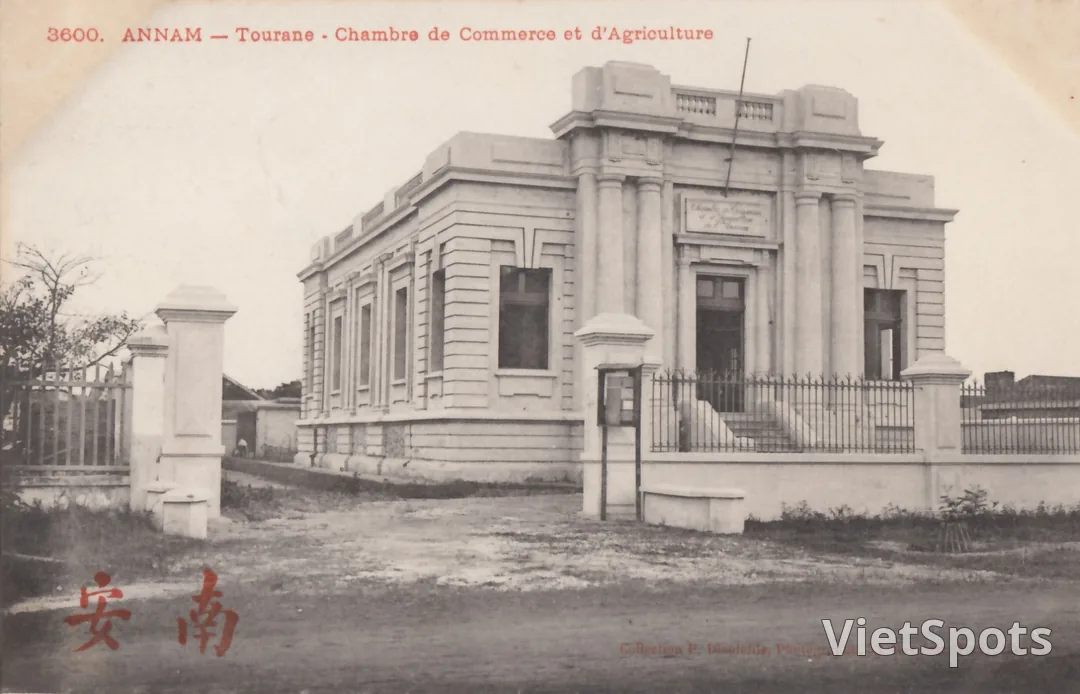
Here, the French built the framework of a port city: the harbor, the roads, and administrative buildings of this style — the Tourane Chamber of Commerce and Agriculture. Low-rise architecture, with rows of columns, iron fences, exactly like what they built in other colonial cities.
Whatever remains, and get to see it
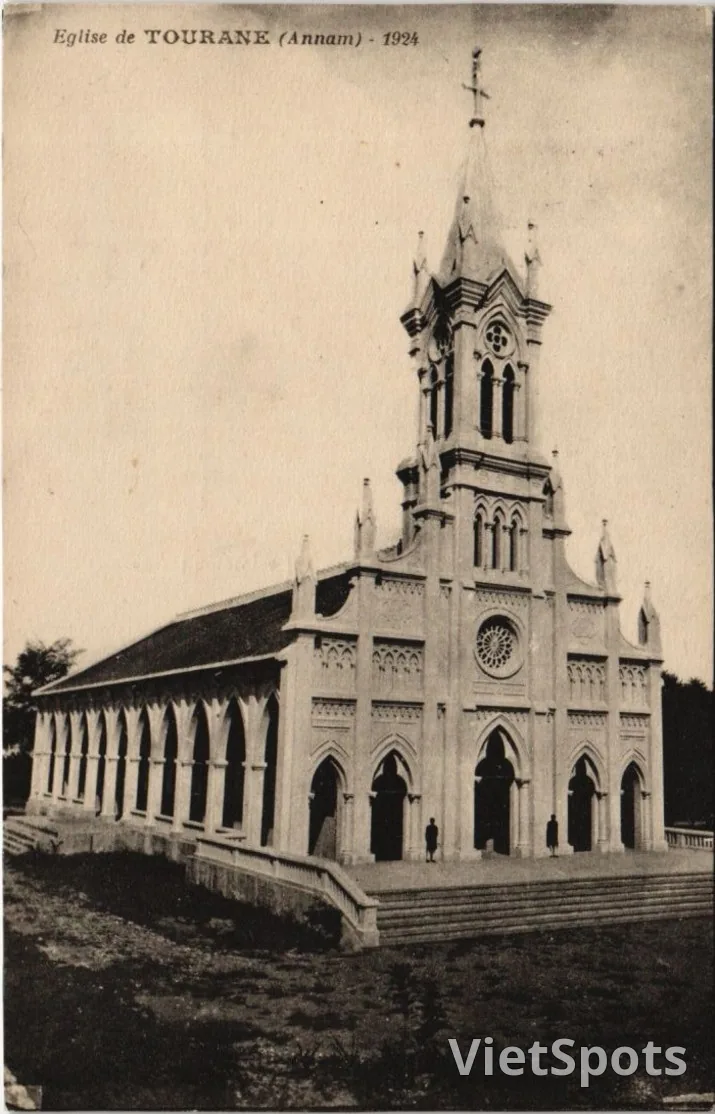
This postcard is dated 1924. The church in the photo still stands there today — people in Đà Nẵng call it the Rooster Church (Nhà thờ Con Gà). If you've walked past it, you'll see it has barely changed. I've written a separate piece about it in the fifteen-minute post and a pink wall.
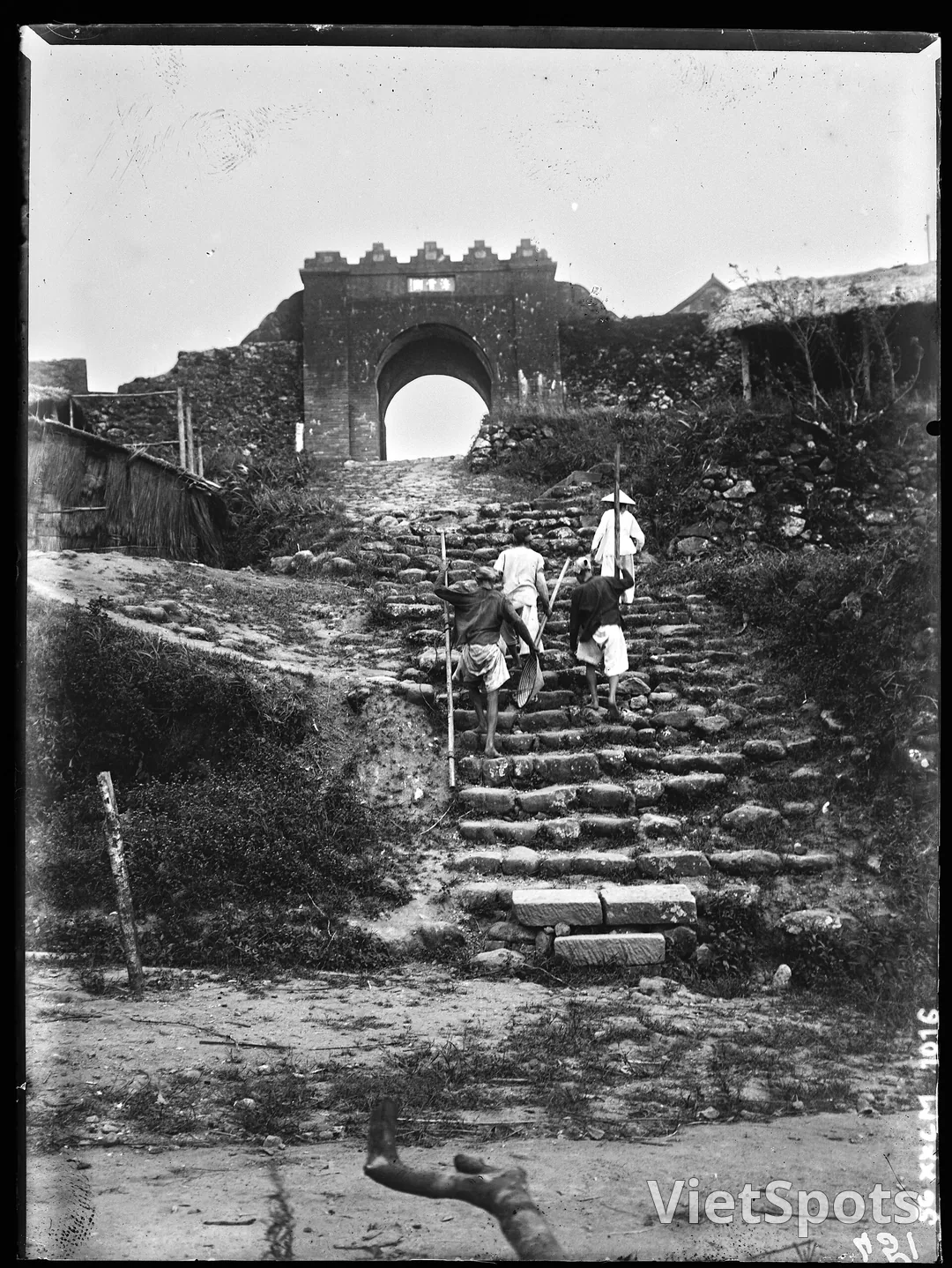
And here is Hải Vân Quan (Ocean Cloud Pass), photographed back when there was no asphalt road yet — a few people carrying goods on shoulder poles are climbing the stone steps up to the gate. This gate predates the French by quite a long time: it was built in the 7th year of Minh Mạng's reign, that is, 1826. The side facing Da Nang is engraved with three characters "Hải Vân Quan"; the side facing the capital Hue is engraved with six characters "Thiên hạ đệ nhất hùng quan" (The Number One Majestic Pass Under Heaven).
There are three ways to cross that pass nowadays — and for every one of them, some people choose wrong — I talked about that in a separate article about Hai Van Pass. If you want to stop at Hai Van Quan, you need to take a car with a driver or drive yourself, because through-buses don't stop there.
The Cham Sculpture Museum was also built during this period, and it remains the place that preserves the largest collection of Cham sculptures in the country — details in separate article.
Why Da Nang?
The answer to this question dates back further than 1888. Da Nang has a deep-water bay, sheltered from the wind, lying right at the foot of the mountain pass that cuts across the country — meaning whoever holds it holds the gateway to the capital. That is also precisely the reason the first shot of the invasion was fired here in 1858, thirty years before the edict was issued.
Next time you pass by a sign that says Hải Châu or Thạch Thang, you'll know where that name comes from. This city changed its name, changed rulers, changed size many times — but the names of five villages remained.
Archival photo in the public domain — Wikimedia Commons. Tourane postcard: Pierre Dieulefils. Photo of Hai Van Gate: André Salles.
Book Travel in Da Nang — in English on vietSpots
- 🎁 Sign up and get 15 Welcome Pack coupons — e.g. Motorbike Rental 45%
- 👑 Member tier discount up to 15% on site (Silver 5% · Gold 15%)
- 🛂 Auto-fill arrival card📶 Compare lowest eSIM prices🚻 Find toilets

Comments