

Golf in Da Nang: four 18-hole courses, four completely different kinds of challenge



Within a radius of about 40 km around Da Nang, there are four golf courses with 18 holes meeting tournament standards, designed by four completely different renowned names. People visiting here for the first time often default to assuming that "any beach golf course in Central Vietnam is pretty much the same" — but these four courses differ so much that if you pick the wrong one, you could spend an entire day playing a style of golf you don't even enjoy.
This article does not rank which course is better than another. It answers a different, more practical question: if your trip only has time for one or two rounds, which course should you choose?

A quick look at four courts
• Bà Nà Hills — a mountain course set in a valley, par 72, 7,857 yards from the back tees• Montgomerie Links — a hybrid links course by the coast, par 72, 7,091 yards• Hoiana Shores — a pure coastal links course, par 71, 7,004 yards• Vinpearl Nam Hội An — a links course on the sand dunes, par 72, 7,038 yards
Two numbers stand out right from this table. First: Ba Na is nearly 800 yards longer than the other three courses — a gap almost equal to an entire par-5 hole. Second: Hoiana is the only par-71 course in the group, meaning its hole layout was already different on paper.
1. Bà Nà Hills — the only course without a sea view
Three out of four courses are located along the coast. Ba Na, however, sits in a valley at the foot of a mountain range, and that alone changes the whole game: no crosswind off the sea, the air is noticeably cooler, but in exchange the elevation keeps shifting constantly under your feet.
This is the world's first golf course designed by Luke Donald — the former world No. 1 golfer. The layout is divided into two very distinct halves. Nine holes wind through the valley, with relatively wide fairways in a classic parkland style, featuring a natural stream running through. The back nine holes climb gradually up the hillside: the fairway narrows, the elevation changes are steep, and a single bad shot will cost you.

The most memorable holes:
• Hole 5 (par 5, 708 yards) — one of the longest par-5 holes in Vietnam. You have to carry over the water, and then still hit two really accurate long iron shots to reach the green• Hole 12 (par 3) — played completely downhill, with an elevation drop of up to 50 meters from the tee to the green. The general experience here is to club down two numbers compared to the actual distance, otherwise the ball will fly too far• Hole 16 (par 3) — island green, completely surrounded by water, hit from an elevated tee. This hole isn't difficult because of distance, it's difficult because of your mindset.
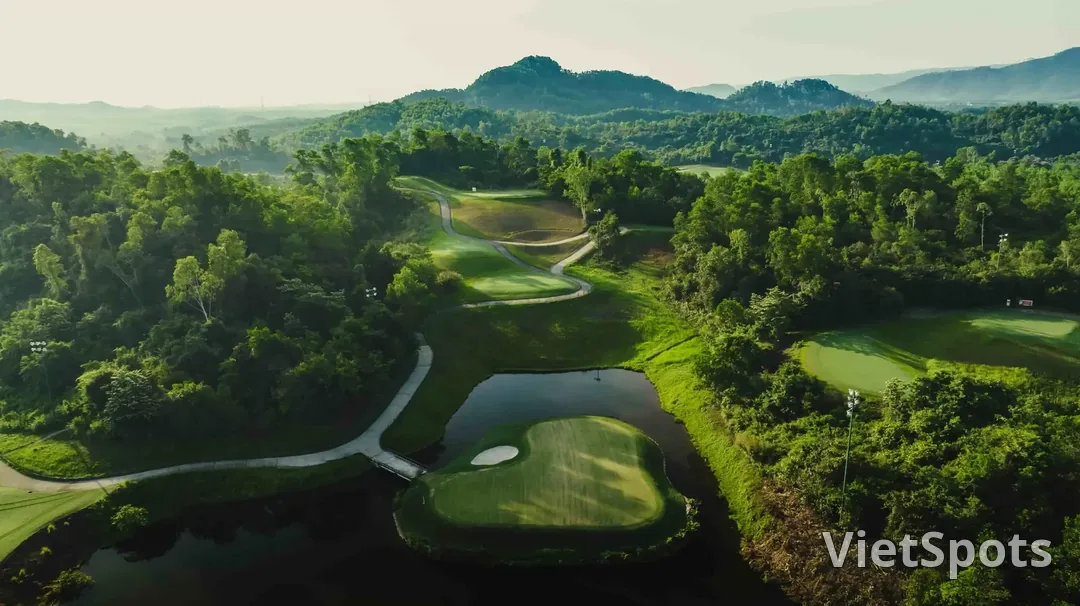
Bà Nà is also the only course in Đà Nẵng where you can play all 18 holes at night — a system of high-mast floodlights covers the entire course. In the photo above, those slender light poles standing along the edge of the trees are exactly that.
Who it's suitable for: people who love terrain variation, who enjoy every hole having its own unique style, and who don't mind climbing slopes. But remember to choose the right tee set — 7,857 yards is the distance for low handicap golfers, while the course has many shorter tee sets for casual players. And bring a pair of shoes with good grip, because the slopes here are truly steep.
→ View details of Ba Na Hills Golf Club
2. Montgomerie Links — the wind must be read from the tops of the casuarina trees

This course bears the name and design signature of Colin Montgomerie — the Scottish legend who topped the European Order of Merit eight times. The executing architect is Brit Stenson, with a philosophy of minimal intervention into the existing sand base. The result is a "hybrid links" course: it has the soul of Scotland, but more trees and softer than a real links course.
What determines the score here is not the length, but the wind and grass direction.
The row of casuarina trees running along the yard not only blocks the wind but also acts as a wind vane. The sea wind here often changes direction depending on the height, so looking at the blades of grass at your feet is looking the wrong way — you have to look up at the tops of the casuarina trees to know which way the wind is blowing up high. On the green, Paspalum grass has a very clear grain direction: with the same putt stroke, rolling with the grain and rolling against the grain appear noticeably different to the naked eye.

Hole 12 (par 5, 527 yards) is the signature hole of the course. The fairway slopes gently uphill, running straight toward the clubhouse, with more than a dozen bunkers scattered on both sides in very treacherous positions. This hole tempts players to try to reach the green in two shots; most should lay up into the gap between the bunker clusters, then play onto the green with a safer third shot.
And there's one detail that no other golf course in the area has: right next to the tee of hole 6, there's still a wartime concrete bunker left exactly where it was, and no one has ever moved it.

Who it's for: people who want to experience the feeling of links golf without going through the full hardship of real links golf yet. It's also the most convenient choice if you're staying in central Da Nang, since the course sits right along the coastal road to Hoi An.
→ View details of Montgomerie Links Vietnam
3. Hoiana Shores — a real links course, and the ball must roll

If those other three courses are "coastal golf," then Hoiana is a true links course: natural sand dunes, clumps of coarse grass, wind blowing straight in from the sea, and almost nothing to block it. This is Robert Trent Jones Jr.'s first design in Vietnam — the designer of Chambers Bay, which hosted the 2015 US Open.
And here is the most important technical difference among all four courses: the turf. The other three courses use Paspalum. Hoiana uses Zeon Zoysia on the fairways and TifEagle Bermuda on the greens — a firmer surface, less grain, and the ball rolls farther.
It sounds technical, but the consequence is very real: at Hoiana, hitting a high lofted shot only makes things harder for yourself. The sea wind will completely swallow up a ball that flies high. The correct way to play is to hit it low and let the ball run — a punch shot, bump-and-run — letting the ball roll onto the green instead of flying in. That's classic Scottish golf course play, and there are very few courses in Vietnam that allow you to play that way.
The last three holes run close to the water's edge and are the most memorable part of the round:
• Hole 16 (par 4) — runs along a strip of white sand right at the river's edge. Playing it safe is around 390 yards; if you're feeling daring, you can try attacking straight at the green from the tee• Hole 17 (par 3) — straight view of Cù Lao Chàm. The course is laid out with two completely different tee boxes to use depending on the wind direction that day• Hole 18 (par 5, 593 yards) — the longest hole on the course, and it plays straight into the prevailing wind. Green has a bunker that people call the "lion's mouth

In March 2025, Hoiana hosted the Women's Amateur Asia-Pacific — the first time this tournament was held in Vietnam. I mention this to show that the course truly meets international competition standards, not just that it's beautiful for photos.
Suitable for: golfers with a solid swing who want a day that truly gives them a story to tell. Beginners can still hit from the short tees, but you should mentally prepare for the wind to cause you to lose more balls than usual. This is also the court farthest from the center of Da Nang among the four courts — if you're in Hoi An, it's the opposite, much closer.
→ See details of Hoiana Shores Golf Club course
4. Vinpearl Nam Hoi An — the most relaxed (easiest on the wallet), and has the biggest bunker in Vietnam

A course designed by IMG Worldwide, opened in 2018, located on a white sand dune strip south of Hoi An. It's also a links-style course by the sea, but much softer than Hoiana: wide fairways, gentle elevation changes — ranging from four to eleven meters between the dunes — and casuarina trees that block some of the wind.
The course's signature feature is its massive waste bunkers running along the fairway. Hole 1 alone has a bunker considered the largest in Vietnam, and it's also the spot where almost everyone who arrives stops to take a photo before teeing off.
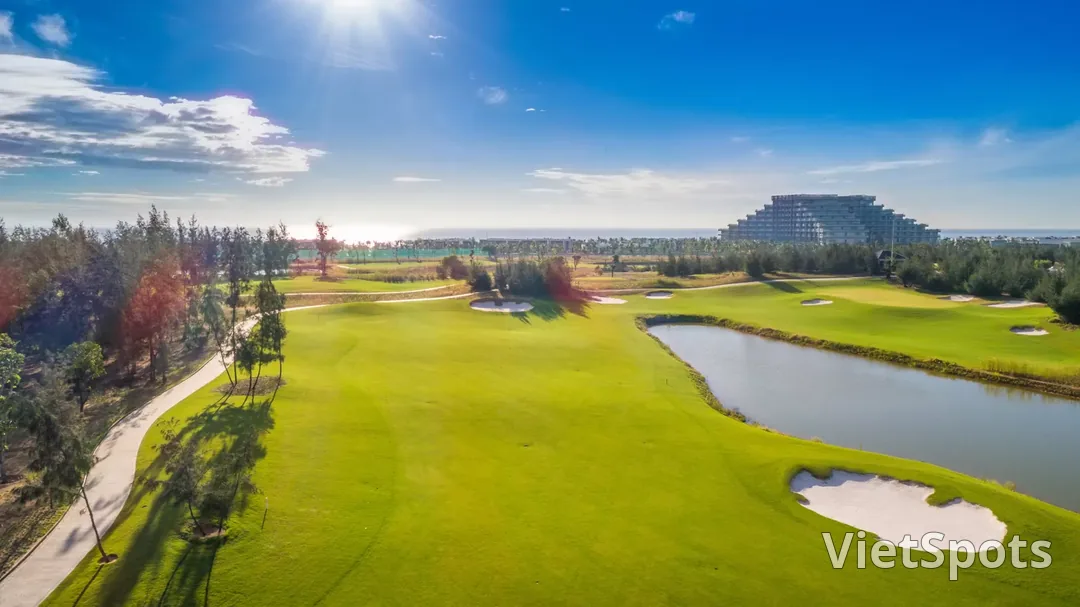
The most intimidating hole is hole 10 (par 4, 459 yards). In the morning it's normal; in the afternoon, when the sea breeze turns around, it becomes the hardest hole on the course. If you're booked for an afternoon tee time, just aim for the left edge of the fairway and accept taking an extra stroke, rather than landing in the soft sand.
Who it suits: beginners; groups with both strong hitters and gentle players; or families coming along, since the whole area has a resort, a private beach and an amusement park right next door. The fairways are wide, so a round of golf here is much less stressful than at the other three courses.
→ See details of Vinpearl Golf Nam Hoi An course
So which venue should I choose?
• Only playing one round, want it to be memorable → Hoiana Shores• Want terrain, want each hole to have its own style → Ba Na Hills• In central Da Nang, want convenient travel → Montgomerie Links• New to golf, or going with family → Vinpearl Nam Hoi An
If you have two days, the recommendation is to choose one beach resort and Ba Na; don't choose two beach resorts in a row. Although the three beach resorts differ in their details, they create the same kind of feeling; Ba Na, however, is quite different. After visiting, you'll feel as though you've just completed two separate trips.
Things you should know before booking
Season. From around September to December is the stormy/rainy season in Central Vietnam — the fairways can get waterlogged, and Bà Nà in particular also gets thick fog. The first half of the year is the best period to play here.
Timing. An early tee time is almost always better: cooler, the wind still light, and the round moves faster. By early afternoon the sun turns harsh and the sea breeze keeps building — at the three coastal courses, the afternoon wind is the biggest variable of the whole round.
Caddie. At all four courses, the caddie is not just the person who carries your clubs. On your first time at the course, they read the wind and read the greens far more accurately than you do. It pays to ask them, especially at Montgomerie (grass direction) and Hoiana (wind direction).
Attire. All four courses require collared shirts, long pants or golf shorts, and soft spike shoes. T-shirts with round necklines, jeans, or flip-flops are not allowed on the course — the courses enforce this strictly, it's not just a casual reminder.
Time. A round at Ba Na usually takes longer than flat courses because of the sloping terrain. If you have other plans in the afternoon, you should leave yourself a generous buffer.
Reservations. Prime time slots on all four courts fill up early, especially on weekends and during peak season. Don't show up and only then look for an open slot.
There's something quite rare in Da Nang that many other golf destinations don't have: these four courses don't tread on each other's toes, but rather complement one another. One mountain course, one pure links course, one links-style hybrid course, and one spacious dune course. Play all four and you'll have experienced nearly every style of golf a coastal region can offer.
You can view the specs, images, and available tee times for all four courses in the golf section of VietSpots.
Photos provided by the golf courses.
Book Travel in Da Nang — in English on VietSpots
- 🎁 Sign up and get 18 Welcome Pack coupons — e.g. Motorbike Rental 45%
- 👑 Member tier discount up to 15% on site (Silver 5% · Gold 15%)
- 🛂 Auto-fill arrival card📶 Compare lowest eSIM prices🚻 Find toilets
Comments