

Mì Phú Chiêm: Why does a bowl of noodles that looks sparse turn out to be the most flavorful dish of the Quang region?



The legendary Quảng noodles from Quảng Phú Chiêm, Cao lau from Hoi An, and Cẩm Hà fish sauce
That folk verse ranks Phú Chiêm noodles first, even ahead of Hội An's cao lầu. People from Quang region are so used to hearing it that they don't even notice, but if you think carefully, it's actually a deliberate arrangement: among the three things mentioned, only Phu Chiem noodles is an everyday dish. The other two are specialties. There must be a reason why a dish that is eaten every day gets put at the top.
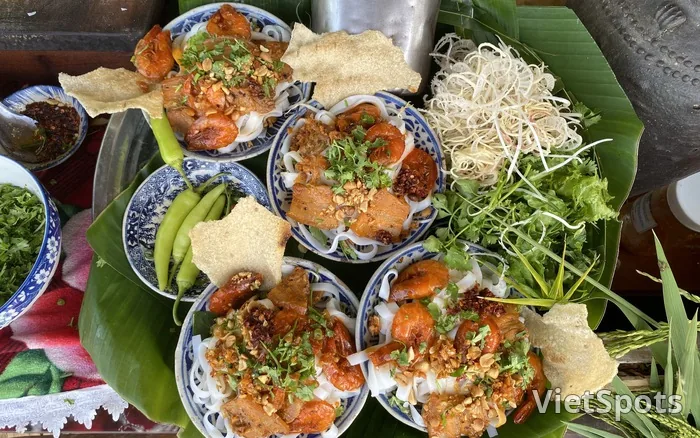
Phú Chiêm is a real village. The village is located in Điện Phương commune, Điện Bàn town, Quảng Nam province — on alluvial land along the Thu Bồn River, right in the middle of the route connecting Đà Nẵng and Hội An. Not a brand name someone came up with, but a place where people still live, still grow rice, and still make noodles.
The way this noodle dish made its way into the everyday life of the two neighboring cities is also special: on people's shoulders.
From early morning, the women of Phú Chiêm carry noodles on foot or by bicycle toward Hội An and Đà Nẵng. One end of the carrying pole holds a pot of hot water with charcoal keeping it warm throughout the journey; the other end has a basket of noodles, fresh vegetables, rice paper, and bowls with chopsticks. There was a time when the whole village had more than two hundred such carrying-pole loads spreading out every day.
The call "Who wants Quang Phu Chiem mi..." has become the sound of morning across the whole region, passed down through many generations. Some families who carry noodles on shoulder poles to sell are now already in their third generation.
The noodle strand starts from a grain of rice, and the grain of rice also has a name.
Phu Chiem people use Xiec rice — a rice variety grown on the alluvial soil of Dien Ban. Rice is soaked, ground into flour, and then steamed into thin sheets over a pot heated by a straw fire — not charcoal, not gas, because straw fire gives even, gentle heat. After the rice paper sheets are steamed, they're brushed with a thin layer of oil using a piece of banana leaf fiber so they don't stick together, then stacked up and cut with a knife.
Sliced by hand, not machine-cut. Villagers say a machine cuts the strands perfectly even, but they turn out sticky and clumped, losing that slightly rough, chewy texture that the hand blade leaves behind. It's the kind of claim that's hard to prove with machinery, but anyone used to eating it can tell the difference.
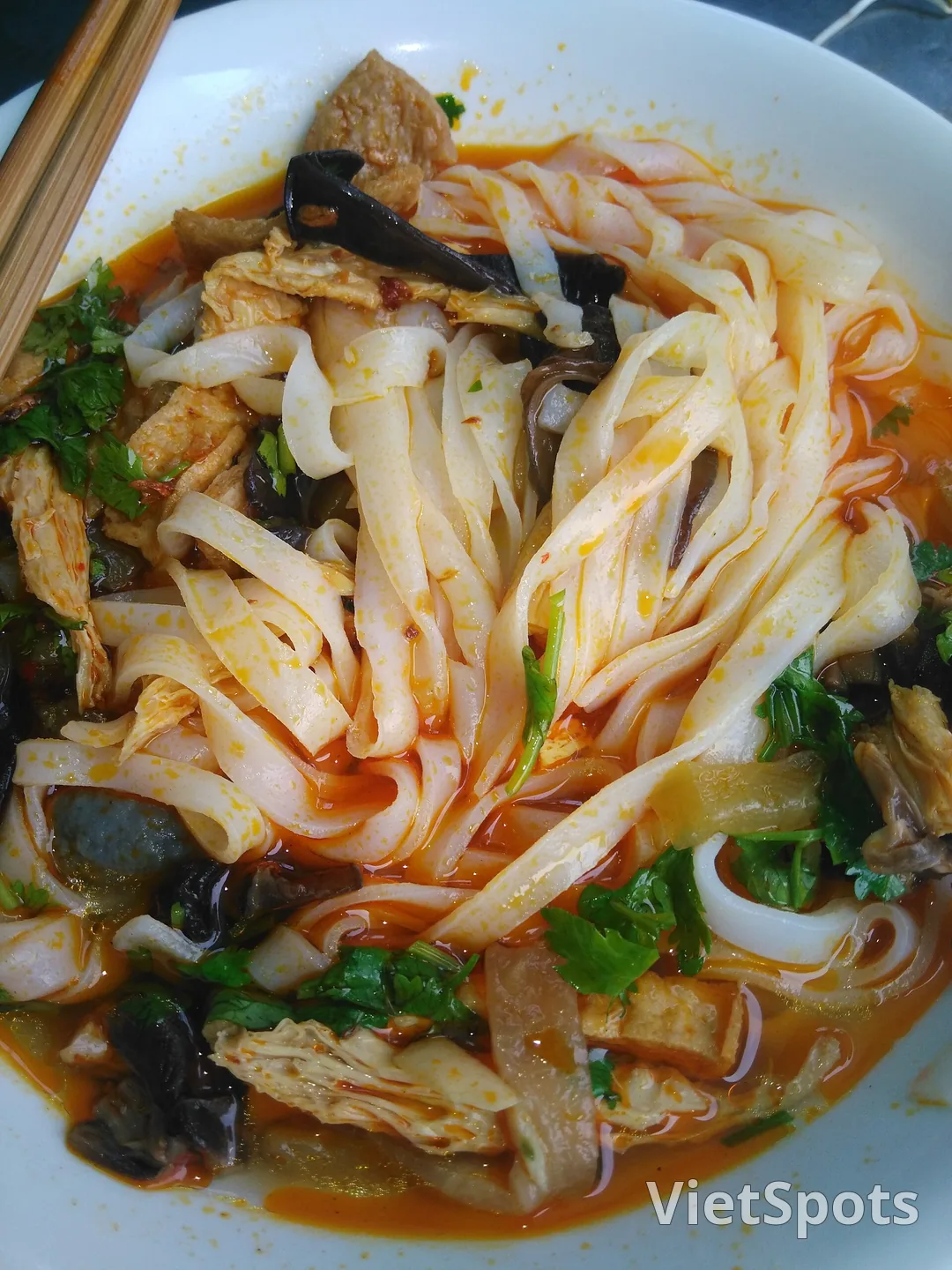
Water — the part that makes up Phú Chiêm.
While mì Quảng in general is usually made with a topping cooked from pork and bones, Phú Chiêm goes a different way: the topping is cooked from freshwater shrimp caught in the Thu Bồn River, with the addition of field crab and beaten egg yolk to make it rich and thick. Don't throw away the shrimp shells — pound them, strain the liquid, and put all the essence into the pot. Soak the peanuts until soft, peel off each layer of the thin skin to remove the bitterness, then grind them finely and add them in.
The sauce isn't the bright turmeric yellow that so many people imagine. It's actually the brick-red color of shrimp and crab, deepened only by fried shallot oil with just a touch of fresh turmeric. Some households add coconut milk, others add peanut sauce — every kitchen has its own recipe, passed down within the family, and no one's is exactly the same as another's.
And this is what often surprises first-time eaters: the broth is extremely minimal. Just barely covering the bottom of the bowl, just enough to soak the noodles, with nothing to slurp. Many customers ask for more broth, and the seller usually just smiles.
That little bit was intentional.
The Phú Chiêm-style broth is simmered down to concentrate it, not to be ladled out generously. The entire flavor of the shrimp, the crab, and the peanuts is condensed into just an amount of water the size of a cup's bottom. If you're brief, the broth turns thin, and thin means ruined. The cook accepts letting the bowl of noodles look a little sparse, in exchange for every spoonful of broth being rich and full-bodied.
I think this is the noodle shop that best captures the local flavor of this place.
Quang Nam's land is not a generous one. The sand is poor and infertile, and every year brings storms and floods. In a place like that, no one has anything to waste — so even shrimp shells are pounded to extract their flavor, and even the thin skins of peanuts are sat down and peeled off, layer by layer. That meticulousness doesn't come from being picky, but from the fact that nothing is allowed to be overlooked.
People here are like that too. We speak little, speak straight to the point, with no beating around the bush. For those from elsewhere meeting us for the first time, it's easy to mistake this directness for coldness, even bluntness. It feels exactly like looking at a bowl of noodles but finding no broth.
But the longer you sit there, you realize the warmth is somewhere else. It's in the vegetable basket—finishing everything and asking for more without anyone charging you. It's in how the vendor remembers that you don't eat scallions, remembering it even the second time. What I like is that they don't say any flowery words, but the bowl of noodles they give me is more generous than it needs to be.
And green chili — that's a must-have; if you eat mì Quảng without green chili and lime, people from Quảng Nam would say it's lost half its deliciousness — and that's exactly right. The green chili isn't fiery red to show off, but bite into it and the spiciness hits straight and sharp, then fades away quickly, without lingering. It's no different from how people speak the truth directly to your face without holding anything back.
In August 2024, the Ministry of Culture, Sports and Tourism added the "Folk Knowledge of Quang Noodles" to the list of National Intangible Cultural Heritage. What is recognized is not a formula, but rather knowledge — that is, the kind of knowing that is passed from person to person in the kitchen, never written down in books.
That's the right way to describe it. Because what's precious in Phu Chiem was never a hidden secret. It's a habit of doing things properly: choosing the right rice variety, patiently tending the straw fire, sitting down to peel the thin skin off each bean by hand, and being willing to end up with a pot of broth that's small in quantity but rich in flavor, rather than a lot that tastes bland.
Next time you eat a bowl of mì Quảng, try not to rush and ask for more broth. Squeeze in some lime, add green chili, break up the rice cracker, then mix everything well from the bottom up — this noodle bowl isn't meant to be slurped, it's meant to be mixed by your own hand to bring out its true flavor.
Like Quang, it doesn't naturally open up to just anyone.
Book Food in Da Nang — in English on VietSpots
- 🎁 Sign up and get 15 Welcome Pack coupons — e.g. Motorbike Rental 45%
- 👑 Member tier discount up to 15% on site (Silver 5% · Gold 15%)
- 🛂 Auto-fill arrival card📶 Compare lowest eSIM prices🚻 Find toilets
Comments