

The bog of vessels begins quietly ― Encountering the pottery of the south, Raiteu ware ―

Recently, I stumbled upon a piece of pottery that really caught my eye. I've always loved tableware, and I even carefully brought some pieces from my favorite artists in Japan with me — but wherever you go, each place has its own charming pottery. I keep telling myself not to accumulate more things (in fact, I should be cutting back), but somehow, before I know it, my collection has grown again. I feel a bit guilty about it, but honestly, at this point, I think it just can't be helped. Everyday life feels stable through something as simple as the texture of the plates, bowls, and teacups we use every day, and when a piece feels just right in your hands, it seems like your outlook on life rises just a little. Today, I want to talk about tableware I encountered in Vietnam. Roughly speaking, the world of Vietnamese tableware has a different feel in the north and the south. In the north there is Bat Trang, and in the south there is Song Be. It's often talked about in those terms. But even a bit of research shows that the boundaries and historical background aren't as simple as I thought. I once talked with a shop owner who knows a lot about Song Be pottery, but honestly, it's really deep and gives the impression of being quite complicated. (The shop owner was incredibly knowledgeable — I learned a lot!) I myself love the rustic charm of Song Be pottery (Gốm Sông Bé), so I've collected pieces and also looked into its history. Originally these were vessels used at food stalls and in ordinary households, so I really wish I could use them casually. But the old pieces have gained historical value and have now become a bit pricey. Since bowls tend to chip or warp as you use them, I'd rather get ones that aren't so expensive. Still, the old pieces are becoming harder to find, so they naturally take on antique value — I suppose it can't be helped. When I learn that there are people carrying on the tradition while creating a "new Sobe," it makes me feel reassured, and it makes me want to cheer them on. And now, alongside Sobe ware, another personal obsession of mine has become Lái Thiêu pottery (Gốm Lái Thiêu). Our encounter was on my husband's birthday. A staff member carried it on his motorbike and delivered it to us as a gift — the large vase he brought us was Lái Thiêu ware. Thank you, Khánh!
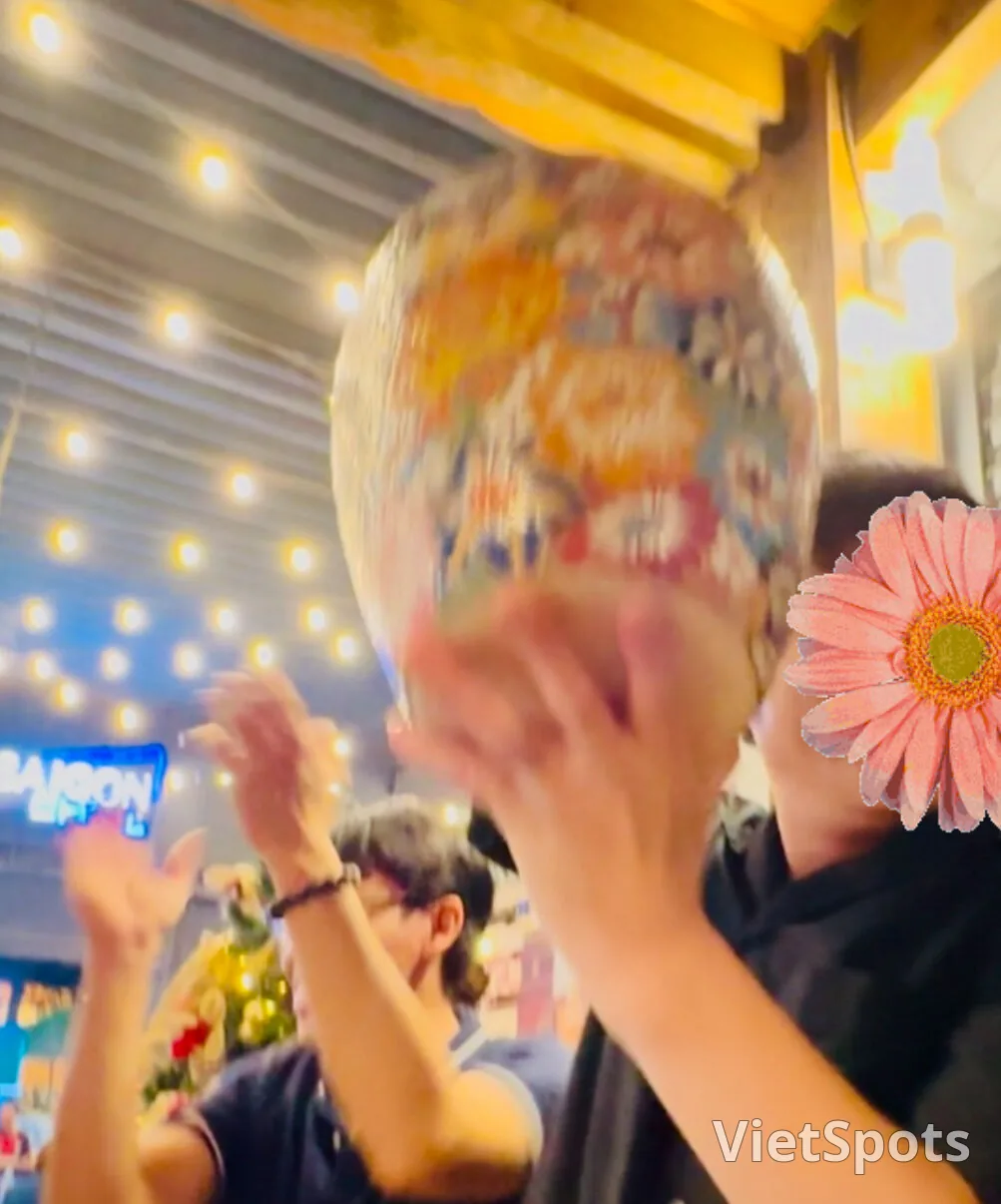
⚫️ The staff's gift totally blew me away with joy~ I'd always been curious about Raiteu pottery, but it's rarely found in ordinary general stores — I'd only ever come across it by chance, or spotted it as a decorative object in a restaurant and think, "oh, that's nice." I never imagined I'd actually be given one as a gift, and it was me, even more than my husband, who ended up jumping for joy in wild celebration. Now it sits proudly in our living room. It's big, so it's lovely just on its own, and I also use it as a vase for displaying branches in a dynamic way. It's honestly the best~
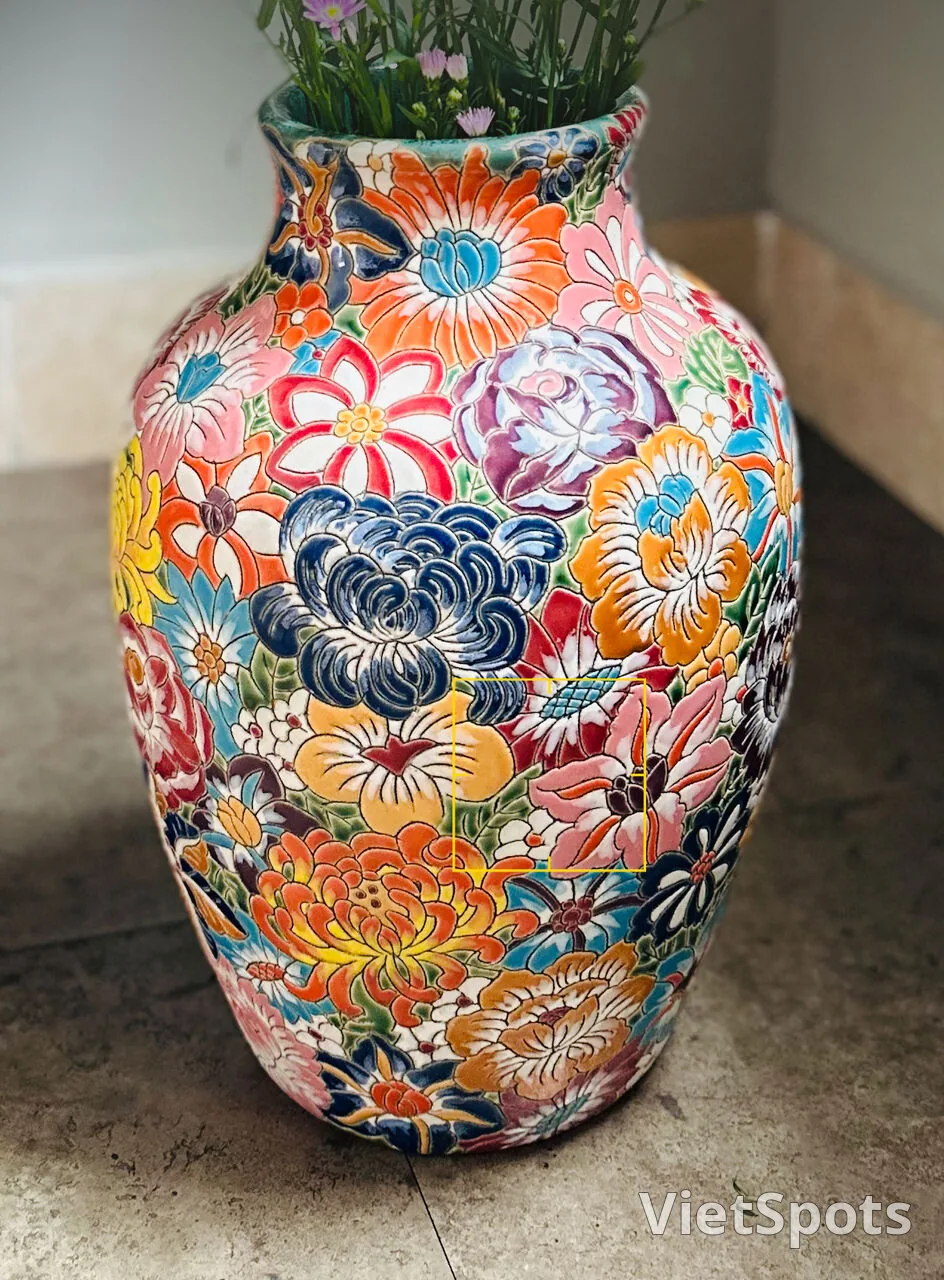
⚫️What I received was abundant with flowers and a mix of colors ~ so flashy~ So then, what exactly is this Lái Thiêu ware? When I looked into it, it really is complicated after all. There don't seem to be many well-organized references in Japanese yet... it's tough. Roughly speaking, it seems that within the pottery known in the south as "Sông Bé ware," there exist, overlapping with it, wares that bear the name of a town called Lái Thiêu. In other words, it's kind of like 'Lái Thiêu within Sông Bé' — the two seem to blend together, without any clear dividing line. The Lái Thiêu ware that draws me in has flower motifs arranged to cover the entire surface. Red, pink, yellow, blue, brown, navy... The sheer number of colors makes it so rich and gorgeous. But it's not too showy — there's something sweet about it, and a rustic charm too~. It has a strange charm, somewhat like a blend of the beautiful painted colors of Kutani or Arita ware and the earthy, familiar warmth of Okinawan yachimun pottery, if I were to compare it to Japan. It's also very Vietnamese and adorable that unique figurines are made, not just vases. The classic motif is the pig. Chickens and small birds are also used as motifs.
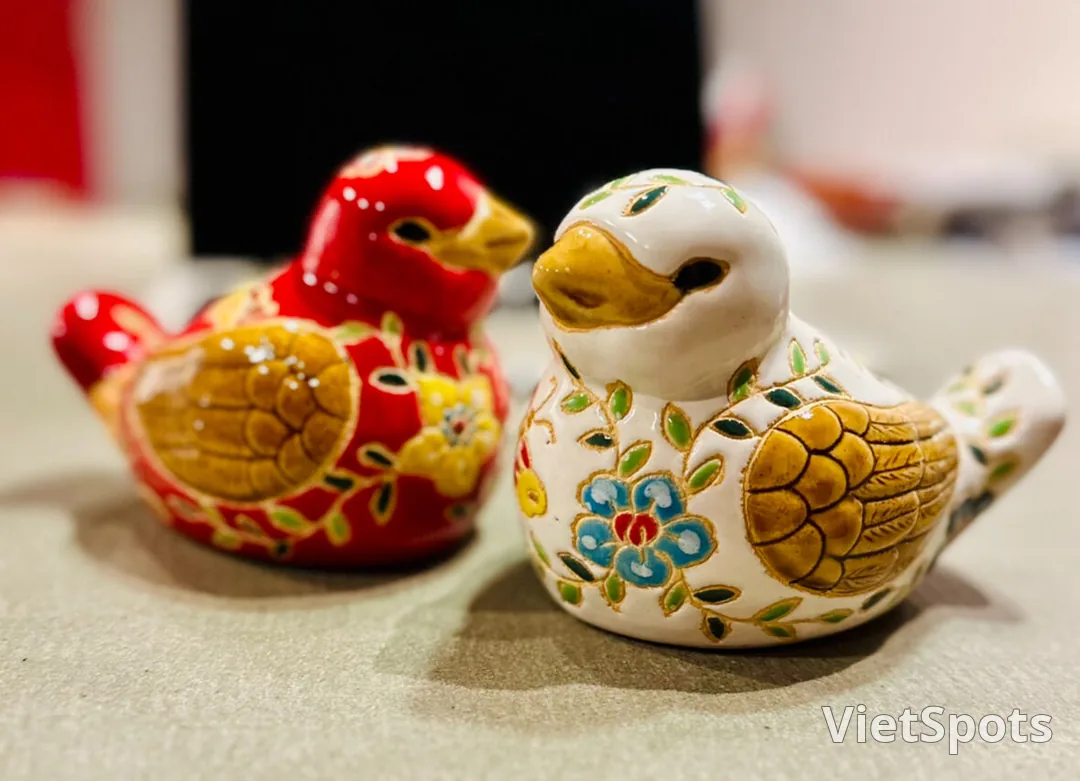
⚫️ A tiny bird small enough to perch on your hand — it resembles a dove-shaped whistle. But what's overwhelmingly more common are, of course, flowers. From nameless little flowers to peonies and lotuses, they're drawn in fine, meticulous detail. Even though these are everyday objects meant for practical use, an enormous amount of work goes into them. There's something fascinating about that imbalance — homely and familiar, yet made with such painstaking craftsmanship. I imagine it must also suit the color sensibility that people in the Nanbu region tend to favor. So why did this kind of pottery come to be? When I looked into it, that turned out to be really interesting too. According to my research, artisans from southern China moved south in the mid-19th century, bringing their techniques with them. The area around Binh Duong Province is blessed with good clay and favorable distribution conditions, so it developed as a center for everyday pottery production. It seems that Chinese ceramic techniques blended with Vietnamese sensibilities, giving rise to a unique world of glazes and patterns. It's also mentioned that in the 1960s there was a 'golden age' when it spread not only within Vietnam but also to Laos, Indonesia, and the Philippines, and that really gets me excited. Japan's Kutani ware and Arita ware also drew attention at the World Expo and were distributed overseas, so somehow I feel a bit of a personal connection there too.
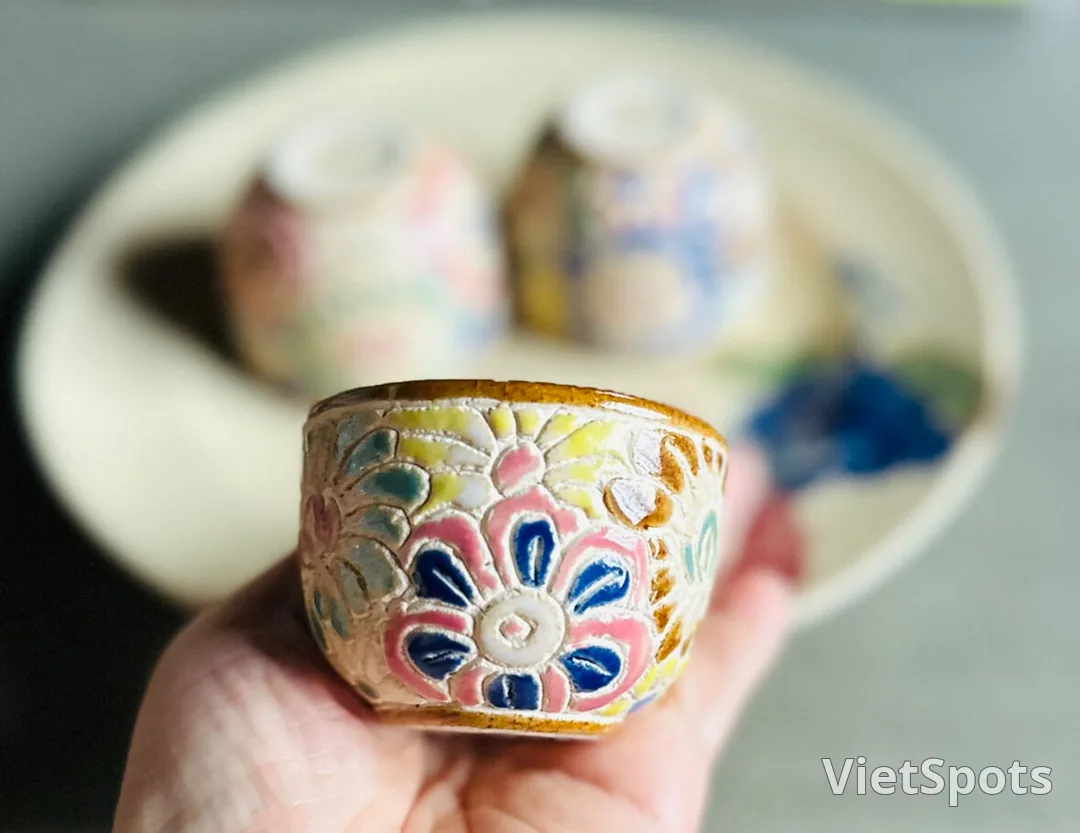
⚫️ A size that fits perfectly in the palm of your hand While that feeling was growing stronger, I came across a small tea set, and quietly ended up buying it. If I had to say, it's a bit rough around the edges, but it's packed full of hand-painted flowers, scattered with deep blue, pastel pink, lotus green, and lemon yellow. I lose track of time just gazing at it. I still haven't told my husband that I bought it, but I think I'll casually brew some tea in it, or put spices in it, and quietly set it out on the dining table.
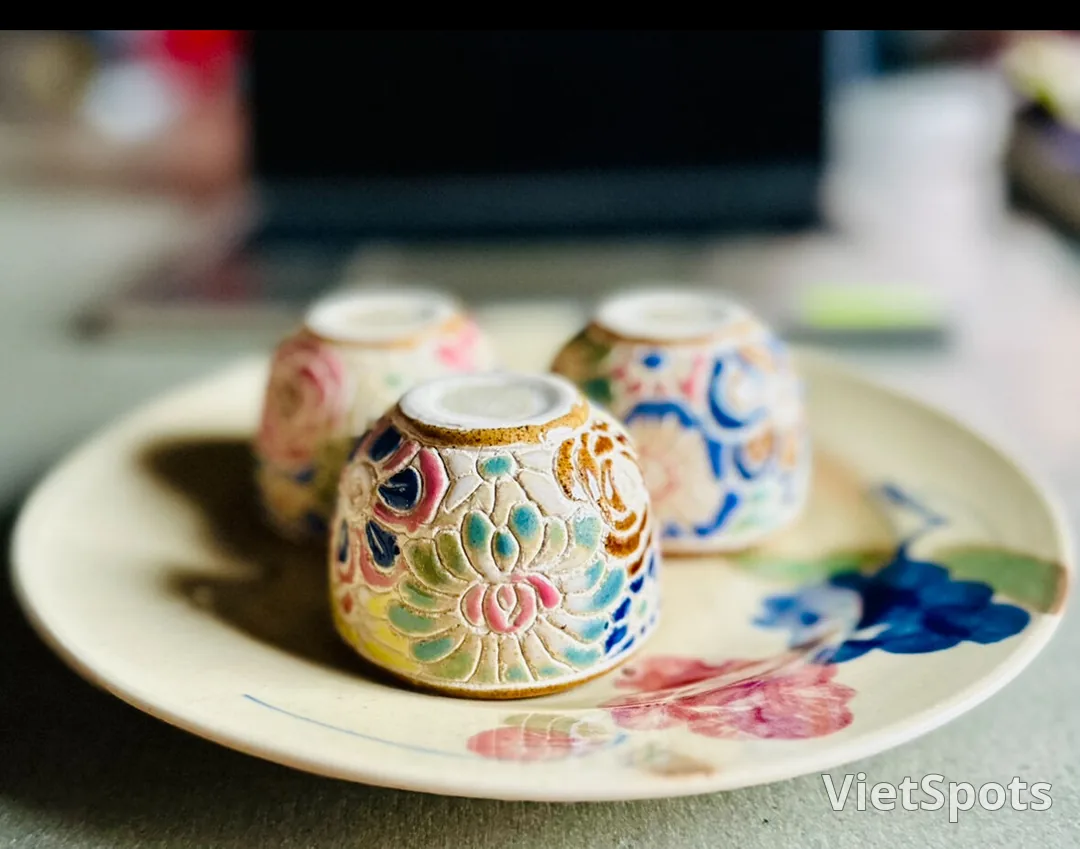
⚫️ Looking closely, the color of every flower is different~ And so, I'm going to dive a little deeper into Lái Thiêu ware. Yet another joy has been added to my everyday life. I referred to the following sources. (Since there still seem to be few well-organized Japanese-language references on Lái Thiêu ware, I mainly relied on Vietnamese and English materials.) Vietnam Pictorial (Vietnam News Agency) "Lai Thieu Pottery" https://vietnam.vnanet.vn/english/long-form/lai-thieu-pottery-321686.html Endless Vacation Lai Thieu Pottery – A Beautiful Feature of Southern Vietnamese Culture" https://endlessvacation.vn/gom-lai-thieu-net-dep-van-hoa-nam-bo/ Art Home "History of Lai Thieu Pottery, Binh Duong https://online.art-home.vn/lich-su-gom-su-lai-thieu VietnamNet "Binh Duong pottery: a rich tradition worth preserving https://vietnamnet.vn/en/binh-duong-pottery-a-rich-tradition-worth-preserving-and-fostering-2250873.html Relocation Life Ranking
Order Shopping in Ho Chi Minh City — in English on vietSpots
- 🎁 Sign up and get 14 Welcome Pack coupons — e.g. Motorbike Rental 45%
- 👑 Member tier discount up to 15% on site (Silver 5% · Gold 15%)
- 🛂 Auto-fill arrival card📶 Compare lowest eSIM prices🚻 Find toilets
Comments