

Golf season in Vietnam: the three regions are nearly half a year out of sync, so there's a nice spot to play no matter what month it is



Golf beginners often ask which course in Vietnam is the most beautiful. But a much more useful question is a different one: where should I play this month?
And in Vietnam, the answer has an unusual feature that few other countries in the region share: there's no month when the whole country is bad at once. The rainy season calendars of the three regions are offset by almost half a year, so there's always at least one region that's right in the middle of its own season.
VietSpots currently has 72 golf courses in 28 provinces and cities — 33 in the North, 23 in the Central region, and 16 in the South. Of these, 30 courses have more than 18 holes, meaning you can play two days without repeating the same route; in particular, Phoenix in Phu Tho and Royal in Ninh Binh each have 54 holes.

The three clocks are running out of sync with each other
Vietnam stretches more than 1,600 km from north to south, and that doesn't just change the accent — it also changes the rainy season. Let's keep it short:
• The North has four seasons, with winter being the hardest time to visit• The Central region gets rain at the end of the year, right when the North is at its most beautiful• The South has only two seasons, with rain starting from mid-year• The Da Lat plateau is almost untouched by all three
Those four calendars never align perfectly for any single month. That's why a golfer in Vietnam can play all year round and almost never has to take an off-season.
1. The North — 33 fields, and a winter that transformed the turf
The North has the most courts in the country. Most are clustered around Hanoi and then spread out to the midland provinces northwest of the capital, where hills and lakes are naturally abundant — so courts in the North are often hillside courts with a lake nearby, rather than perfectly flat ones.
The seasons here are very clearly divided:
• September to November — the most beautiful time. Dry, cool, golden sunshine, gentle breeze. If you can only take one trip to the North all year, choose this period• December to February — cold with a lot of drizzle. The course is still open, but the grass slows down when the temperature drops: the fairway changes color, the surface gets harder and sparser, and the ball rolls very differently than in summer• March to April — it warms up again and the grass recovers, but it gets sticky and humid. There are days when the humidity is nearly at saturation point, and the course surface is wet even though it isn't raining• From May to August — hot and humid, with some days reaching nearly 40 degrees. You can still play, but you have to tee off very early
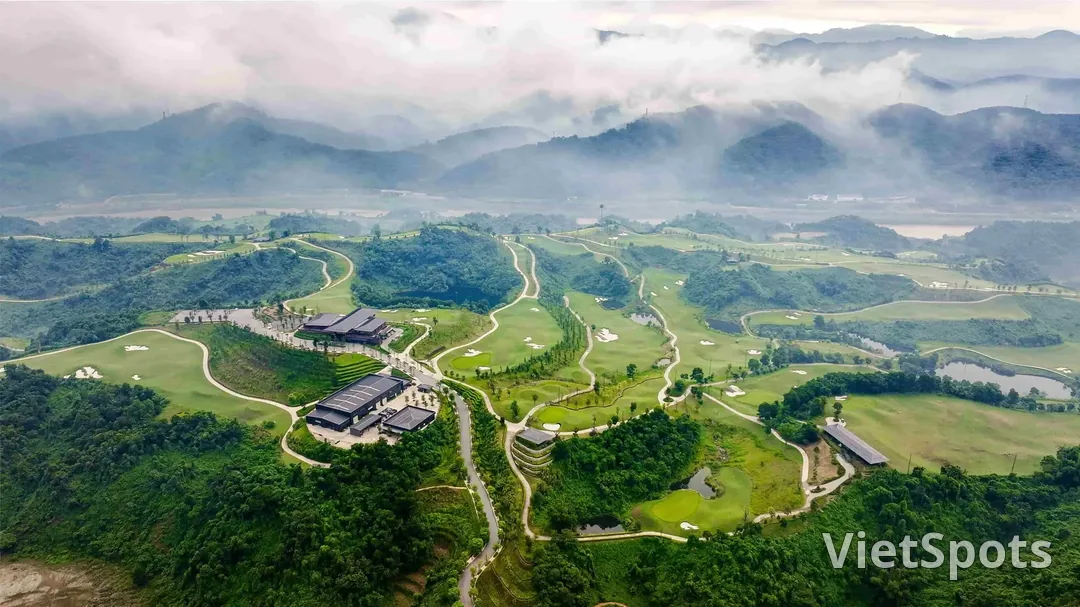
The North is also home to some of the most unbelievably located courses. Sapa Grand sits in the mountains of Lào Cai, and on many mornings the clouds hang lower than the fairway itself.

FLC Hạ Long offers something that almost no other course in Vietnam has: standing on the green and looking straight out at the limestone karsts of the bay.

As for Tam Dao, it's a completely different style — ancient trees, shade, a slow pace of play, closer to a classic parkland course than a resort course.
2. Central Region — 23 courses, and a season out of phase with the North
This is what makes Vietnam's golf map so interesting. The Central region rains exactly when the North is at its most beautiful, and is beautiful exactly when the North is at its hottest.
• September to December — storm and rainy season. The fairway can be waterlogged for days on end, and the playing schedule can easily get thrown off• February to August — the golden stretch. Dry, sunny, calm sea• Only from May to July there is a southwest foehn wind, which locals here call the "Lao wind": dry and scorching hot, blowing continuously for many days. It won't damage the playing course, but it will change the ball's trajectory and make you lose fluids faster than you'd think
In other words: in June, when Hanoi is so sweltering that no one wants to go outside, Da Nang, Nha Trang, or Quy Nhon are still in the middle of their beautiful season.

The coastal strip from Hue to Binh Thuan is where almost all of Vietnam's links golf courses are concentrated. The reason is simple: sand and wind are already there, so there's no need to build fake terrain. KN Golf Links Cam Ranh is a clear example — the course sits on sandy ground with a backdrop of bare hills.

Laguna Lang Co is nestled between the mountains and the bay, making it one of the very few places where, within a single round of golf, you can see forest, lagoon, and sea all at once.
As for the Đà Nẵng – Hội An cluster alone, it's so packed with things to see that it really deserves its own separate article. I wrote here, comparing four 18-hole golf courses located within a radius of about 40 km, and how different they are from one another.
3. Southern region — 16 courts, lots of rain but rarely loses a round
The South only has two seasons, and the most important thing to know is: the rainy season here is not like the rainy season in Central Vietnam.
Central Vietnam has prolonged rain, sometimes not letting up for an entire week. Southern Vietnam has sudden downpours — usually falling in the early afternoon, heavy but brief, then clearing up completely. This means that even during the rainy season from May to October, an early-morning tee time can still go through a full 18 holes almost as normal.
• November to April — dry season, the most beautiful time, and also when the course is busiest• May to October — afternoon rain. Early tee times are almost unaffected

Southern courses are mostly parkland style: flat, with large trees, and plenty of lakes. Since the terrain is flat plains, water is the main hazard rather than slope — quite the opposite of the hilly Northern courses. Long Thanh is a typical example of this type of golf course.

4. Đà Lạt — the clock that doesn't run
Then there's a position that's outside all three of the above schedules.
Đà Lạt sits at an altitude of about 1,500 meters. The temperature stays year-round at a level that the lowlands only experience for a few weeks a year. The rainy season still exists, roughly from May to October, but even when it rains, the weather stays cool — not hot and humid like it is in the lowlands.
A very practical consequence: in June and July, when the North is hot and the South gets afternoon rain, Da Lat is the most pleasant place in the country to walk 18 holes.

And the course here doesn't look like anywhere else in Vietnam either. Instead of coconut and casuarina trees, there are three-needle pines. The grass is cool-climate green. In some spots they've even planted hydrangeas right along the fairway's edge — something no coastal course could ever manage to grow.

Dalat Palace is the oldest course in the group and also the course with the most pine trees.
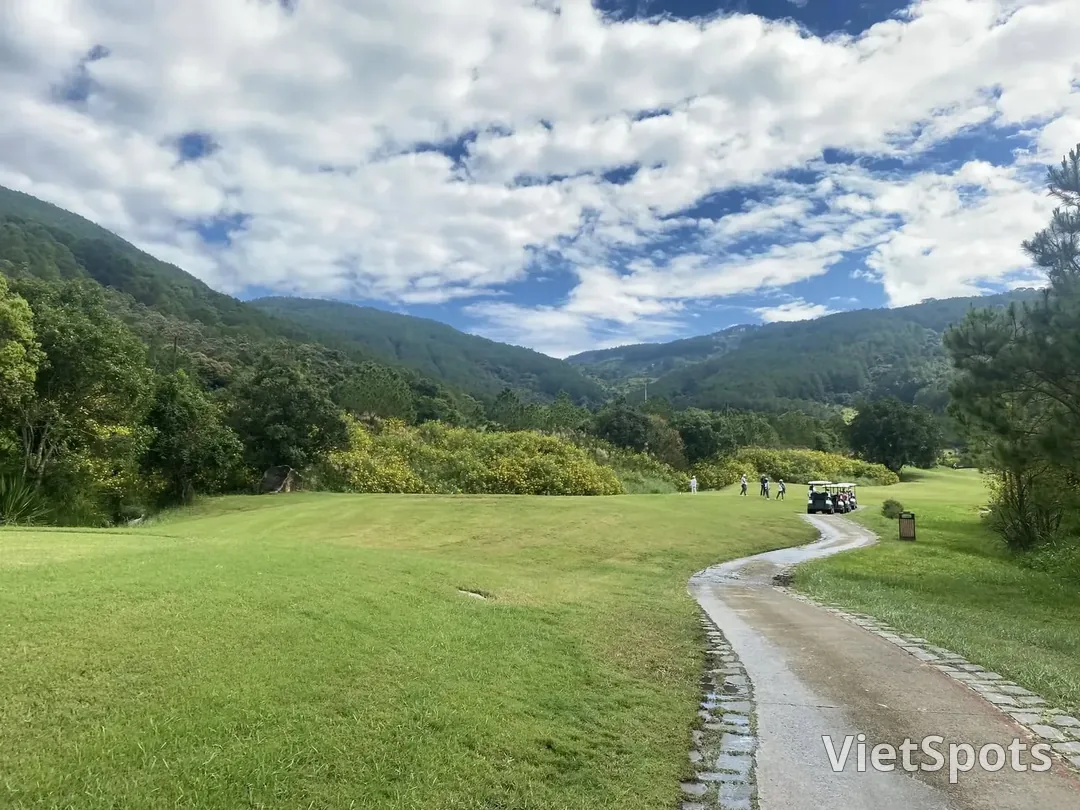
As for The Dalat at 1200, it sits right in a pine valley. Around October and November, wild sunflowers bloom bright yellow, lining both sides of the tram road — time your visit right, and the round of golf becomes a whole different experience.
Which month to go where — quick summary table
• January–February → the South and Da Lat. The North is cold, and the Central region still has late rains• March–April → both the South and the Central region are beautiful. The North is warming up again but prone to damp, muggy weather• May–July → Central Vietnam and Đà Lạt. The North is hot, the South has started having afternoon rain• In August → Central Vietnam is still beautiful, the season starts to change at the end of the month• September–November → the North, the most beautiful season of the year. Central Vietnam should be avoided• December → Southern Vietnam enters the dry season. Northern Vietnam is already cold, Central Vietnam still has rain
The season changes many things, not just whether it rains or shines
Grass surface. On the same course in the North, October and January are almost like two different courses. Cold weather stunts the grass growth, making the fairway harder and sparser — the ball rolls farther, but the lie is worse.
Fog. Hilly courses in the North often have fog in the early morning. The first tee time of the day sometimes has to be pushed back, and on some of the higher holes, visibility can be almost zero during the first half hour.
Wind. At the links courses along the coast of Central Vietnam, every hole is exposed to wind. In the morning the wind is light, but by noon it grows stronger. On the very same hole, a 6 a.m. tee time and a 2 p.m. tee time can differ by as much as two strokes.
Drainage. After a heavy rain, courses on the Southern delta plains hold water much longer than sandy coastal courses. Links courses are the opposite — once the rain stops for a while, the course surface dries out again.
In many countries, golfers have to wait for the season. In Vietnam, it's almost the opposite: the season is always available somewhere, the only question is how far you're willing to travel.
Seen that way, the 72 courses spread across 28 provinces and cities are no longer just a long list, but a calendar — every month of the year, there are always a few places at their very best.
Specs, photos, and open tee times for all courses can be viewed in the golf section of VietSpots.
Photo courtesy of the golf courses.
Book Travel in Da Nang — in English on VietSpots
- 🎁 Sign up and get 15 Welcome Pack coupons — e.g. Motorbike Rental 45%
- 👑 Member tier discount up to 15% on site (Silver 5% · Gold 15%)
- 🛂 Auto-fill arrival card📶 Compare lowest eSIM prices🚻 Find toilets
Comments